

01
Governance
Can governments devote greater attention to policy implementation when electoral cycles are less frequent?
A Forum for Legal, Constitutional & Public Policy Dialogue
India's democracy is not merely a system of elections. It is a living constitutional relationship between institutions, citizens, rights and responsibilities.
Jurists for Justice Foundation seeks to contribute to that relationship by creating spaces where constitutional questions can be examined with independence, scholarship and reason.
Through dialogue among jurists, former judges, members of the Bar, academicians, policymakers, civil society and informed citizens, the Foundation seeks to encourage thoughtful engagement with the legal and institutional questions that shape India's democratic future.
Our objective is not simply to debate public questions, but to deepen the quality of that debate and present its outcomes before the Joint Parliamentary Committee, ensuring that diverse views and legitimate concerns are duly considered in the legislative process.
Jurists for Justice Foundation is a non-political organisation of jurists, functioning under the patronage and guidance of several distinguished retired Judges of the Hon’ble Supreme Court of India, High Courts and the District Judiciary. The primary object of the Foundation is to raise and deliberate upon significant legal and constitutional issues, to facilitate informed debate, to explore workable solutions, and to act as a guardian for the protection of constitutional values.
The Foundation seeks to bring together distinguished members of the legal fraternity and wider intellectual community to examine issues that have a direct bearing on India's constitutional framework and democratic institutions.
Its work is founded upon three principles:
Respect for the Constitution as the foundational framework of India's democratic order.
Encouraging reasoned examination of complex public questions beyond partisan boundaries.
Connecting legal and institutional discourse with the larger interests of citizens and the nation.
We envision an India where significant constitutional and institutional questions are examined through informed debate, legal scholarship and democratic participation.
Where disagreement is not treated as division
Where reform is not separated from constitutional principles
Where institutions are strengthened through dialogue
Where citizens understand not only what is being proposed, but why it matters
A National Constitutional Conversation
India is entering an important constitutional conversation about the future of its electoral architecture.
The proposal for simultaneous elections has generated substantial discussion concerning governance, electoral expenditure, administrative resources, federalism, democratic accountability and constitutional design. The current parliamentary examination is centred on the Constitution (129th Amendment) Bill, 2024 and the Union Territories Laws (Amendment) Bill, 2024.
Jurists for Justice Foundation seeks to contribute to this conversation through informed, balanced and constitutionally grounded dialogue.
India has historically experienced periods of simultaneous elections. Elections to the Lok Sabha and State Legislative Assemblies were conducted together from 1951 to 1967, before the electoral cycles became progressively misaligned.
Today, the debate concerns much more than election scheduling. It raises fundamental questions:
Can governments devote greater attention to policy implementation when electoral cycles are less frequent?
Can reducing repeated electoral exercises ease administrative and financial pressures?
Can electoral synchronisation coexist with strong accountability between elections?
How can national electoral synchronisation preserve the constitutional importance of India's States?
How can simultaneous elections protect the legitimate space of regional and smaller political parties?
What safeguards are necessary if governments fall before completing their normal tenure?
9 Cities · 9 States · One National Conversation
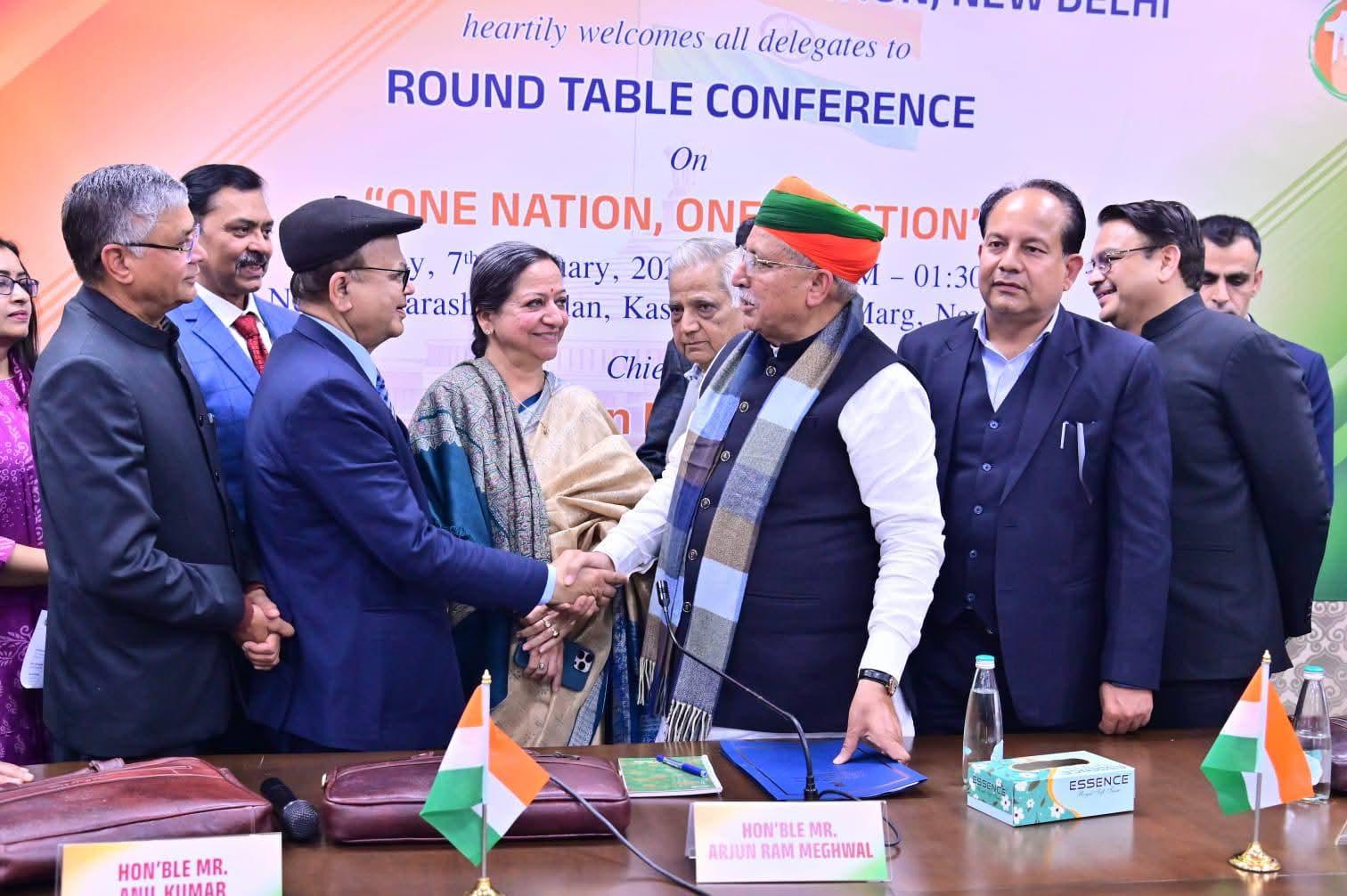
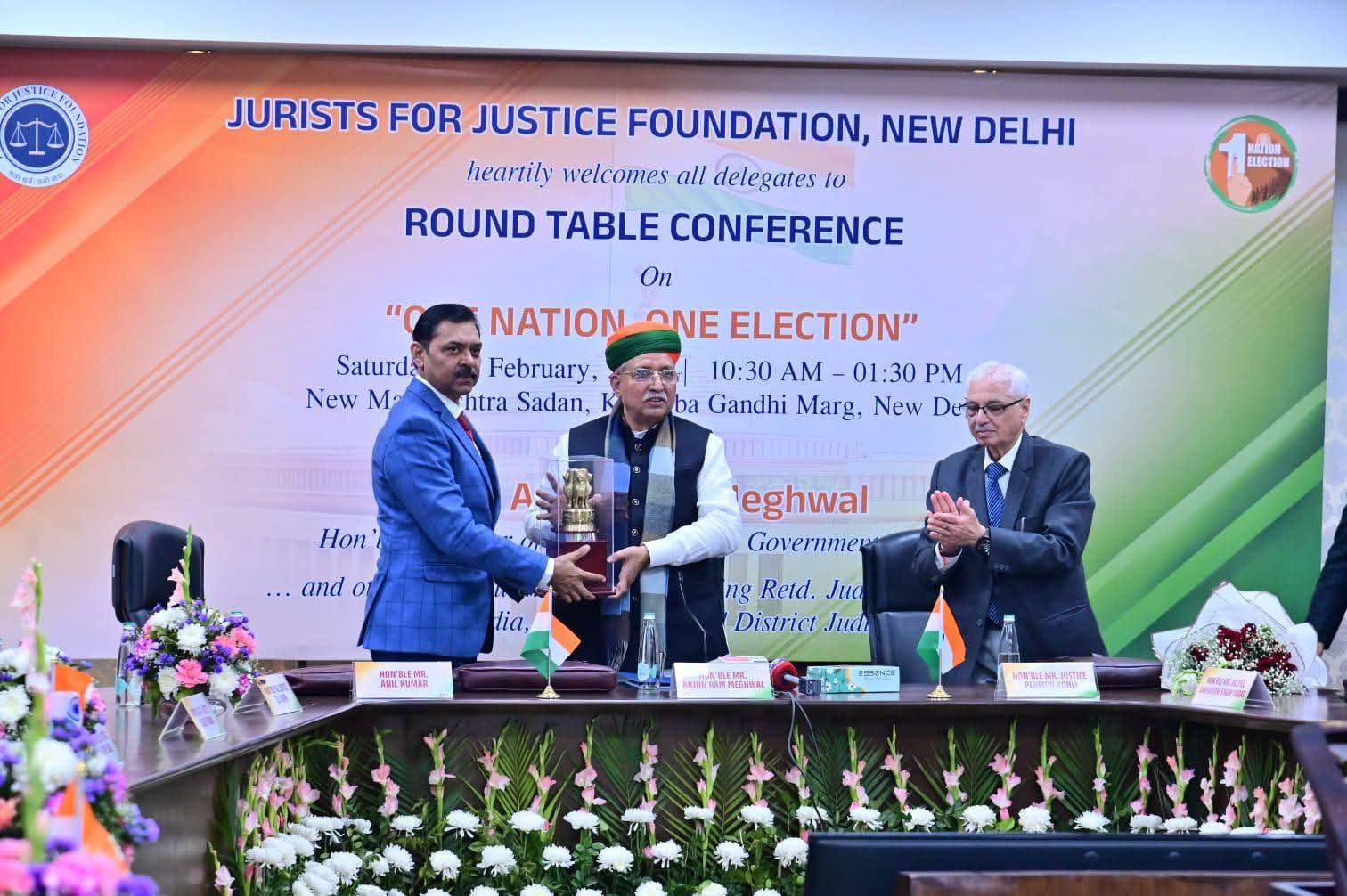
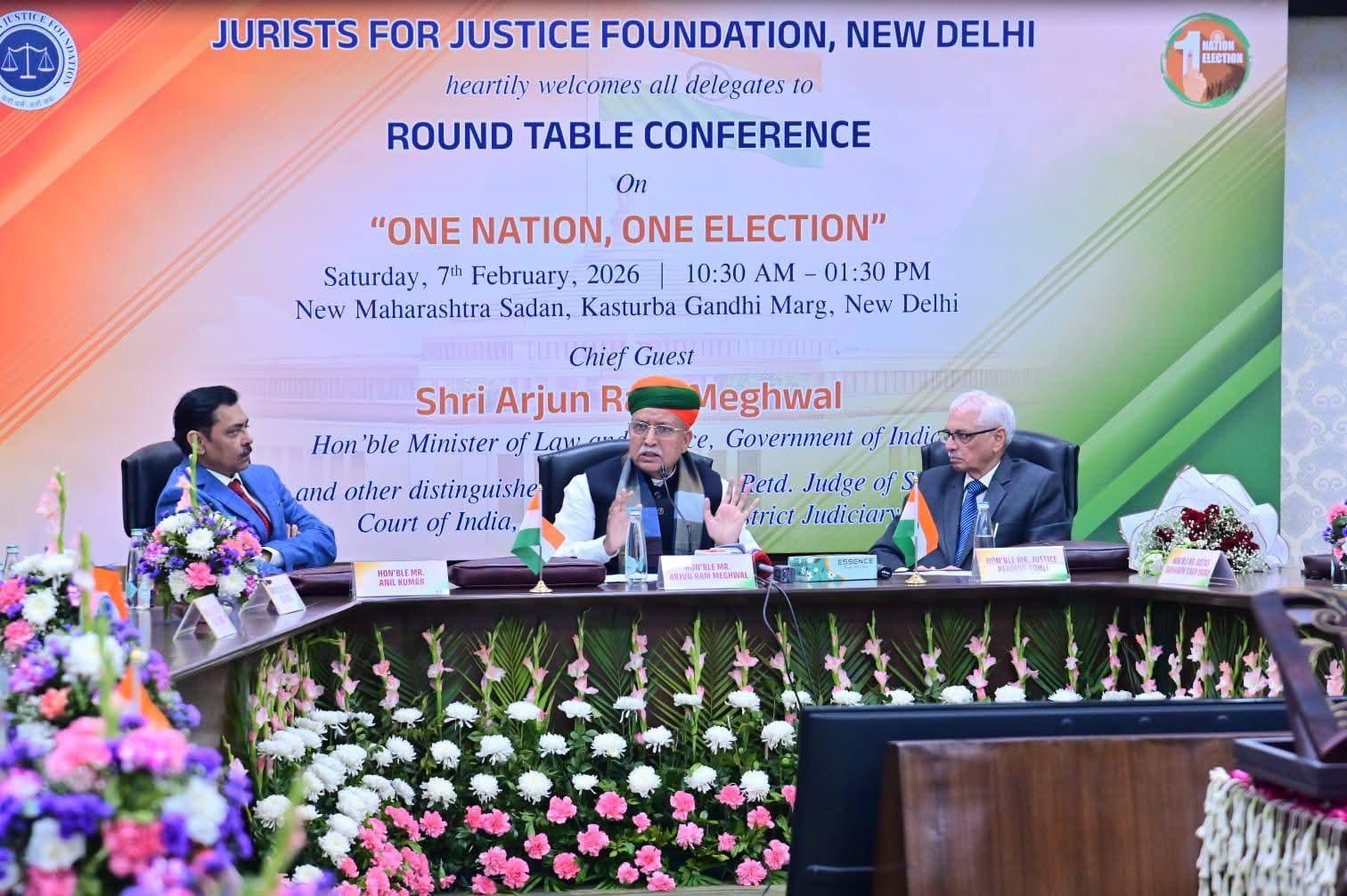
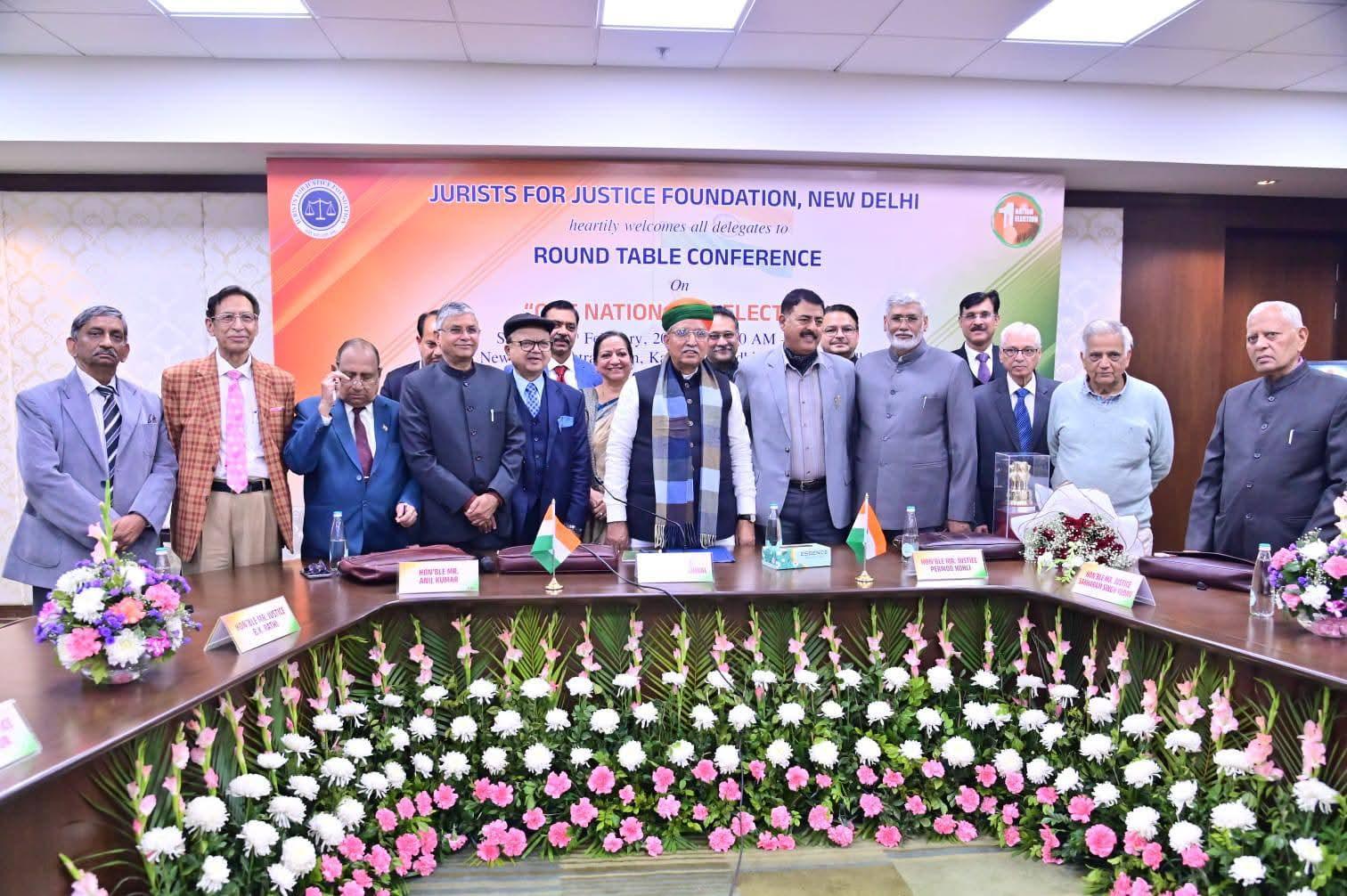
Shri Arjun Ram Meghwal
Hon'ble Minister of Law and Justice, Government of India
And Hon’ble Former Judges of Supreme Court, High courts distinguished academician and Jurists.
The inaugural national conference marked the beginning of the Foundation's initiative to facilitate structured constitutional dialogue on One Nation, One Election.
30 August 2026
IMC Chamber of Commerce & Industry, Churchgate, Mumbai
Lucknow · Kolkata · Chennai · Shimla · Ahmedabad · Jaipur · Bhopal · Dehradun
And many more cities to follow.
Tracking the Report on Simultaneous Elections
The Constitution (129th Amendment) Bill, 2024 and the Union Territories Laws (Amendment) Bill, 2024 were introduced in the Lok Sabha in December 2024 and, on the same day, referred to a Joint Parliamentary Committee (JPC) for wider consultation across political parties, legal experts and the public before any final legislative decision.
The Committee, chaired by BJP MP Shri.P.P. Chaudhary has since been expanded to 41 members drawn from the Lok Sabha and the Rajya Sabha, with representation from all major political parties.
The JPC has been travelling across India to hear directly from citizens, social organisations, NGOs, academicians, legal experts, retired judges and members of the public. As of mid-2026, the Committee had visited roughly a third of India's states, with further visits ongoing, as it has prioritised gathering a broad range of views before finalising its recommendations.
The Committee has heard presentations from several former Chief Justices of India, including Justice Shri. Jagdish Singh Khehar and Justice Shri. D.Y. Chandrachud, on the constitutional dimensions of simultaneous elections. The Law Commission of India, led by Justice Shri Dinesh Maheshwari, has also briefed the Committee, offering the assessment that the proposal is within Parliament's legislative competence and does not conflict with the Basic Structure doctrine.
The Committee's tenure — and the deadline for submitting its report — has been extended several times as consultations have continued:
Bills referred to the Joint Parliamentary Committee.
Lok Sabha extends the reporting deadline to the Winter Session, 2025.
Tenure further extended to the Monsoon Session, 2026.
Committee, having visited only about ten states, seeks additional time; tenure extended toward the Winter Session, 2026.
The Committee's report has not yet been presented to Parliament. Its chairman has indicated that the report will be finalised only once consultations across all states are complete, making early introduction of the Bill in its amended form unlikely before that process concludes. The proposed framework envisages a target implementation year of 2029, subject to the Committee's final recommendations and subsequent parliamentary approval.
The JPC's recommendations are advisory in nature. Once submitted, the report is expected to inform the Union Cabinet's consideration of the Bills, which would then return to Parliament for debate and passage — including the two-thirds majority required for a constitutional amendment.
The future of a democracy is shaped not only by the laws it enacts, but by the quality of the questions it is willing to ask.
Jurists for Justice Foundation seeks to create that space for questions, dialogue and informed constitutional thought.
“One Nation, One Election: A Hallmark of India’s Constitutional Vision.”